ELECROMAGNETIC GENERATORS
DYNAMOS
A dynamo is an electrical generator that produces direct current with the use of a commutator. Dynamos were the first electrical generators capable of delivering power for industry, and the foundation upon which many other later electric-power conversion devices were based, including the electric motor, the alternating-current alternator, and the rotary converter. Today, the simpler alternator dominates large scale power generation, for efficiency, reliability and cost reasons. A dynamo has the disadvantages of a mechanical commutator. Also, converting alternating to direct current using power rectification devices (vacuum tube or more recently solid state) is effective and usually economical.

ALTERNATORS
An alternator is an electrical generator that converts mechanical energy to electrical energy in the form of alternating current.[2] For reasons of cost and simplicity, most alternators use a rotating magnetic field with a stationary armature.[3] Occasionally, a linear alternator or a rotating armature with a stationary magnetic field is used. In principle, any AC electrical generator can be called an alternator, but usually the term refers to small rotating machines driven by automotive and other internal combustion engines. An alternator that uses a permanent magnet for its magnetic field is called a magneto. Alternators in power stations driven by steam turbines are called turbo-alternators. Large 50 or 60 Hz three phase alternators in power plants generate most of the world's electric power, which is distributed by electric power grids.[4]

ELECTRIC MOTORS
An electric motor is an electrical machine that converts electrical energy into mechanical energy. The reverse of this is the conversion of mechanical energy into electrical energy and is done by an electric generator.
In normal motoring mode, most electric motors operate through the interaction between an electric motor's magnetic field and winding currents to generate force within the motor. In certain applications, such as in the transportation industry with traction motors, electric motors can operate in both motoring and generating or braking modes to also produce electrical energy from mechanical energy.

RELAYS
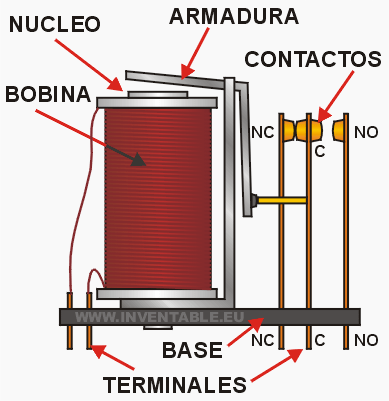
A relay is an electrically operated switch. Many relays use an electromagnet to mechanically operate a switch, but other operating principles are also used, such as solid-state relays. Relays are used where it is necessary to control a circuit by a separate low-power signal, or where several circuits must be controlled by one signal. The first relays were used in long distance telegraph circuits as amplifiers: they repeated the signal coming in from one circuit and re-transmitted it on another circuit. Relays were used extensively in telephone exchanges and early computers to perform logical operations.

No hay comentarios:
Publicar un comentario